
 Materials & Finishes
Walk through a Christmas market in Vienna, browse a gift shop in Vermont, or scroll through photos of other people’s Scandinavian-looking trees, and you’ll see the same soft little crowd everywhere. Foxes, mice, mushrooms, stars, gingerbread houses, all in felt. Wool felt ornaments have become the default for anyone who wants a tree that looks handmade rather than bought in bulk.
They also raise a fair question. Why does one felt fox cost three dollars and another cost twenty-five? The short answer is the wool. The longer answer involves sheep, soap, a great deal of elbow grease and, now and then, a moth.
What Felt Actually Is
Felt is older than woven cloth. Some of the oldest surviving pieces, found in the Altai mountains of Siberia, are around 2,500 years old, and nomadic families in Central Asia still make felt for their yurts.
It isn’t woven or knitted. Look at a wool fiber under a microscope and you’ll see it’s covered in tiny overlapping scales, a bit like a pine cone. Add warm water, a little soap and a lot of rubbing, and those scales open up, catch on each other and lock tight as the fibers tangle. Keep going and you end up with a dense, strong fabric made of nothing but wool. That’s why a real wool felt ornament feels firm and springy in your hand rather than flat and papery.
Why Prices Run From $2 to $30
Most of the price gap comes from one word on the label, or the lack of it. “Felt” can mean quite different materials.
| Type of felt | What it’s made of | How it looks and feels | How it lasts |
|---|---|---|---|
| 100% wool felt | Only sheep’s wool | Soft, dense, springy, deep matte color | Excellent, can last for decades |
| Wool blend felt | Usually 20% to 35% wool mixed with rayon | Smooth and fairly soft | Good, may pill a little with handling |
| Acrylic craft felt | Plastic fibers | Thin, slightly shiny, stiff | Pills and loses shape quickly |
| Polyester or recycled PET felt | Plastic fibers, sometimes from bottles | Stiff and very uniform | Holds its shape but looks flat |
The squeaky felt sheets sold cheaply in craft stores are nearly always acrylic. They’re great for a rainy afternoon with the kids. On a tree, they fuzz up, fade and slump within a season or two.
The other half of the price is time. In US and European shops you’ll usually find acrylic, machine-cut shapes somewhere between $1 and $4. Simple wool blend ornaments run $4 to $8, and hand-stitched 100% wool pieces $8 to $15. A needle felted animal can easily reach $15 to $35 or more, because somebody spent hours on it. If a “handmade 100% wool” animal is selling for the price of a latte, either the wool content isn’t what the label claims, or somebody in the chain isn’t being paid properly for their hours.
Merino, while we’re here, gives a fine, velvety felt with bright colors. Coarser wools make a firmer felt that holds crisp shapes, which is why many makers prefer them for sculpted animals. Neither is better. It depends on the ornament.
How They’re Made
Most wool felt ornaments are made by hand in one of three ways, sometimes combined.
Wet felting is the oldest. Loose wool is shaped, soaked in hot soapy water, and rubbed and rolled by hand until the fibers lock. Felt balls are made this way, rolled between the palms again and again until they shrink into firm little spheres. Nepal is especially known for it, and a good share of the world’s felt balls are rolled there.
Needle felting is how the small 3D animals get their faces. The maker jabs a cloud of dry wool thousands of times with a special needle that has tiny barbs along its tip. Every jab drags fibers deeper and knots them tighter, and slowly a fox or an owl appears. A single small animal can take one to several hours, and anyone who has tried it will tell you about the time they stabbed a thumb.
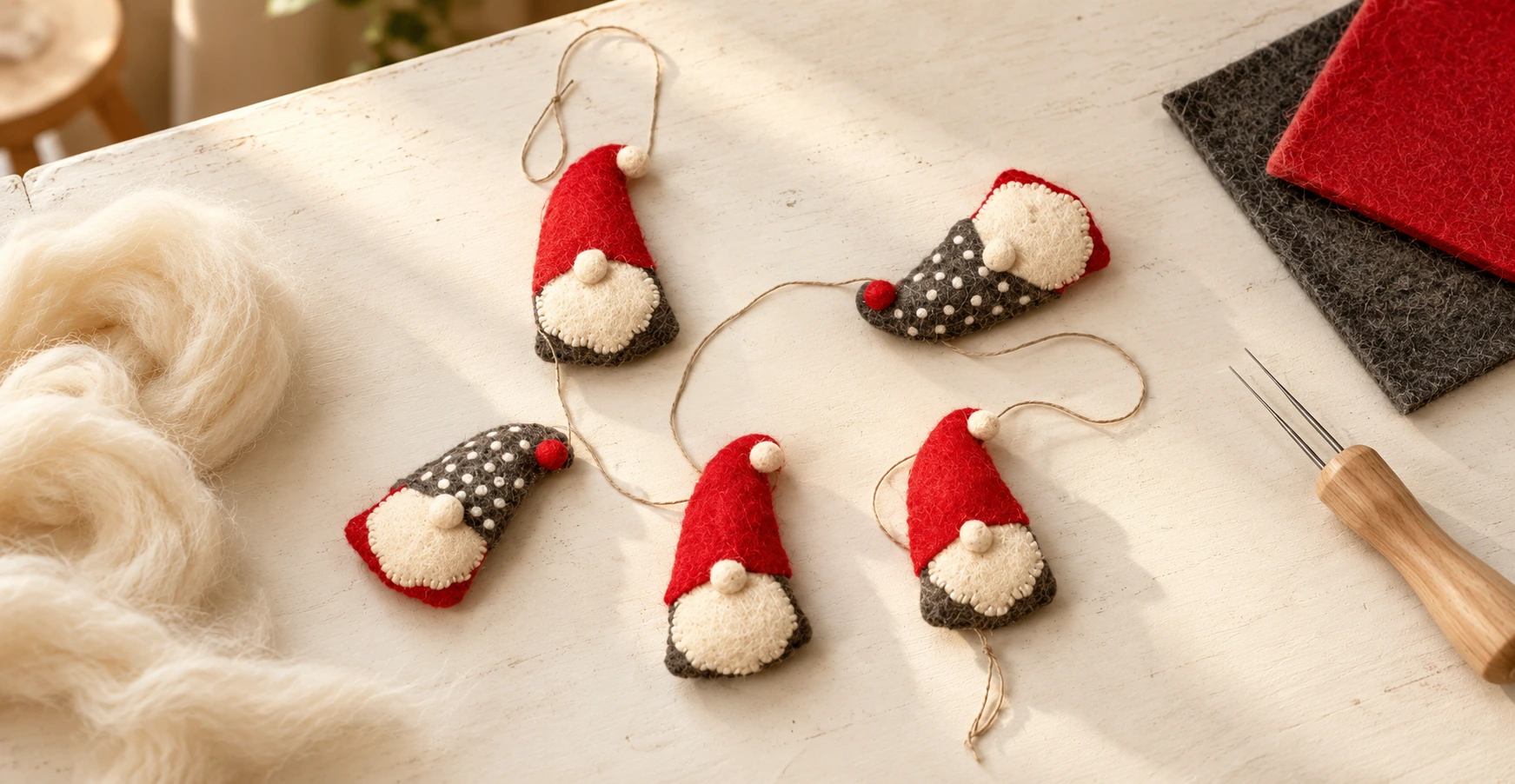
Cut and stitch is the third, and the most forgiving. Shapes like stars, hearts and reindeer are cut from flat wool felt, two layers are stitched together by hand, often with a neat blanket stitch, and lightly stuffed. Embroidery adds the faces and snowflakes.
Beads, bells, sequins, ribbon and hanging loops go on last. Some animals get a thin wire inside their legs or tail so they can perch on a branch.
Why People Switch From Glass
They don’t break, for a start. Drop one on a tile floor and it just sits there looking up at you. If you have a toddler, a Labrador or a cat who treats the bottom branches as a personal gym, that alone settles the argument.
They’re light, too, so they can hang right out on the thin tips where a glass bauble would drag the branch down. Under tree lights, wool has a soft, matte glow that shiny ornaments can’t copy.
Wool is also a renewable fiber that breaks down at the end of its life. And it resists flame better than plastic does, needing far more heat to catch and tending to smolder out rather than melt. Fireproof, though? No. Keep felt away from candles.
Then there’s the handmade part. No two faces or stitches come out quite the same, and stored well, a good wool ornament can easily outlive the person who bought it.
Spotting a Good One in About Ten Seconds
Squeeze it first. Good wool felt feels firm and springs back. Felt that squashes flat and stays there is usually a thin blend or acrylic. Then look at the edges, which should be clean and dense rather than frayed or see-through.
Check the stitching, which should be even and close with no loose ends, and give the hanging loop a small tug. It should be stitched right through the ornament. A loop that’s only glued on top will come off sooner or later, usually while you’re taking the tree down. A little glue on small details is normal. Visible blobs or glued seams mean somebody was rushing.
Finally, wipe a damp white cloth over it. Good dyes won’t leave color behind. And read the label. “100% wool” should be stated clearly. If it just says “felt”, ask.
Who Made It, and Does That Matter?
Most handmade felt comes from small workshops and home-based makers, a large share of them in Nepal and India. In many of them, the work is done largely by women, often fitted around childcare and household work, and paid by the piece.
That’s worth a thought when you’re shopping. A fair price on the tag doesn’t guarantee fair pay further down the line, but a suspiciously low one almost guarantees the opposite. If it matters to you, ask the seller who made the pieces and how they’re paid. Some sellers can point to a fair trade membership. Others can at least tell you about the workshop. A seller who has no idea is telling you something too.
Timing matters as well, and it’s something shoppers rarely see. When stores place Christmas orders early in the year, makers get steady work across the months. When everything is ordered late, it turns into a frantic autumn rush, and that’s when quality slips and hours get long.
Hanging Them So They Stay Put
Use proper ornament hooks or a loop of thin ribbon rather than bending the loop over a branch, which slowly stretches it. Heavier pieces go on the stronger branches near the trunk. Animals with wire in their legs can be clipped straight onto a twig so they look as if they’ve landed there.
Beyond the Tree
Felt ornaments are too nice to live in a box eleven months of the year. String a few into a garland across a mantel or a window. Tie one onto a present instead of a bow, and the wrapping becomes a second gift. Tuck them into a wreath with greenery and dried orange slices, or hang them from bare branches in a tall vase on a side table.
They work outside of December as well. Eggs and bunnies for Easter, pumpkins and bats in October, birds and flowers in spring.
Keeping Them for Twenty Years
Everyday care is simple. A lint roller or a soft clothes brush takes off dust. For a mark, dab with a cloth dampened in cool water and a drop of wool wash, without rubbing, because rubbing felts the surface further. Never put felt in the washing machine or the dryer. It’ll shrink and lose its shape. A squashed ear or tail recovers if you hold it over kettle steam for a few seconds and pinch it back into shape, and small bobbles snip off with nail scissors.
The real danger is the storage box. Clothes moths and carpet beetles love wool, and they can quietly eat holes through a collection over one summer. So make sure every ornament is clean and completely dry before it’s packed. Wrap each one loosely in acid-free tissue, or use egg cartons for small ones. Store them in a sealed plastic box rather than cardboard, add a few cedar blocks or lavender sachets, and keep the box somewhere cool and dry. Hot attics and damp basements are both hard on wool. Open it once in midsummer and have a look.
If you buy vintage or second-hand felt ornaments, seal them in a bag and put them in the freezer for a few days before they join the rest. The cold kills any moth eggs hiding in the wool.
Kids and Pets
Felt is far safer than glass, but it’s still a decoration rather than a toy. Beads, bells and other small parts can come loose, and they’re a choking risk for young children. Hang the ornaments with small details higher up, and keep an eye on puppies and cats who like to chew. Many stores in Europe and the UK label felt decorations “not a toy” for exactly this reason.
If You Sell Felt Ornaments
Christmas ranges are usually booked many months ahead, so the stock is on your shelves by the time shoppers start looking in the fall. Get the wool content in writing so your labels are accurate. Many buyers also ask for azo-free dyes, and some markets have specific rules for decorations that look like toys, so raise that early.
Themed groups sell better than random single pieces. Woodland animals, a Nordic winter, a gingerbread village. Shoppers like buying a small story.
We’re biased, obviously. At FELTORA our wool felt ornaments are made and finished by hand in India, and we help trade buyers plan seasonal collections that land in good time to sell.
Worth the Box Space
A wool felt ornament is a small thing. Somebody still spent an hour or more making it, and it’ll pick up a memory every December you unwrap it. Buy real wool, check the stitching, keep the moths out of the box, and it should still be on the tree when the kids who hang it today have kids of their own.
Frequently Asked Questions
Are wool felt ornaments eco-friendly?
Wool is renewable and breaks down at the end of its life, so 100% wool felt is a greener choice than plastic. Dyes and trims vary, so ask the maker if it matters to you.
Can felt ornaments get wet?
A little moisture won’t hurt. If one gets soaked, press the water out gently with a towel, reshape it, and let it air dry away from direct heat.
Why does my felt ornament smell a little when it’s damp?
Wool naturally contains lanolin, and damp wool can smell faintly earthy. It fades as the ornament dries.
What’s the difference between felt and felted wool?
Felt is made straight from loose fibers. Felted wool starts as a knitted or woven fabric that’s been shrunk on purpose so the stitches lock. Both are wool, but felt is usually denser.
Can I make my own wool felt ornaments?
Yes, and cut-and-stitch shapes are the easiest start. Buy 100% wool felt sheets, trace a star or heart, cut two layers and blanket stitch the edges with embroidery floss. Needle felting takes more practice, and the needles are sharp, so it’s one for the grown-ups.